FOR POLICY DEVELOPERSEvaluate submitted policies.
Researchers submit a policy to a site with matching robot hardware. The volunteer site team runs it on maintained real-world tasks.
A PHYSICAL BENCHMARK NETWORK FOR ROBOT MANIPULATION
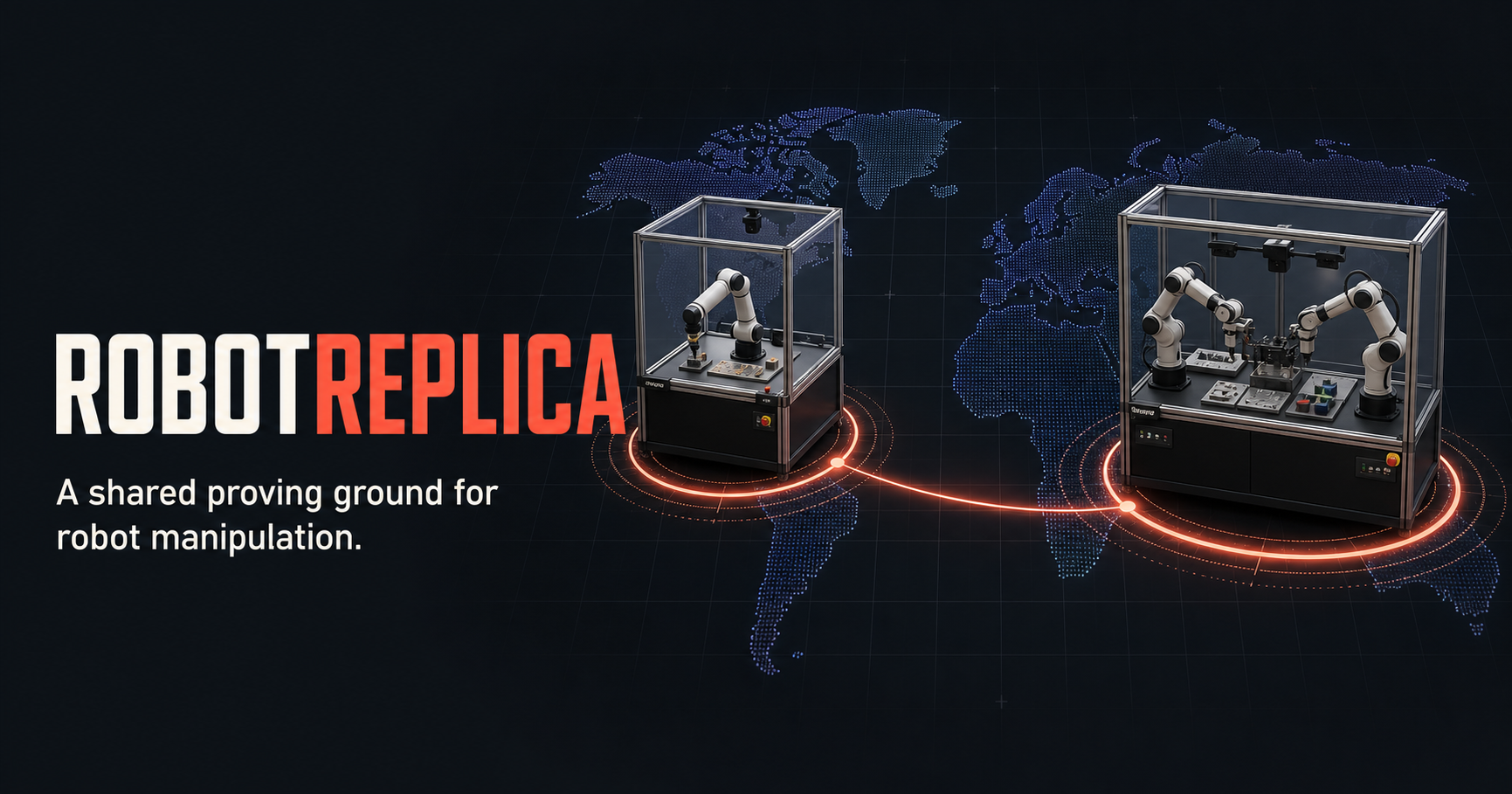
RobotReplica is a non-commercial, community-led research initiative connecting organizations that voluntarily host standardized robot manipulation benchmarks.
Researchers submit a policy to a site with matching robot hardware. The volunteer site team runs it on maintained real-world tasks.
RobotReplica proactively evaluates compatible public policies and checkpoints, verifies the results, and maintains robot-specific leaderboards.
PARTNER ORGANIZATIONS & PEOPLE
 IRVL · UT DallasRichardson, TexasSITE 01: SO-101
 General Intelligence LabsSan Francisco, CaliforniaSITE 02: OpenArm
 GRILL · CornellIthaca, New YorkSITE 03: Tianji Marvin Arms
 PRACTICE · UCLALos Angeles, CaliforniaSITE 05: AgileX PiPER
 IRIS · ASUTempe, ArizonaSITE 06: Allegro Hand
 GRASP · PennPhiladelphia, PennsylvaniaSITE 07: Dual YAM Robots
CURRENT ROBOTREPLICA SITESSeven sites across the United States
Our current network includes seven physical benchmark sites. We welcome additional organizations, robot platforms, and evaluation sites to join RobotReplica.
Become a partnerOVERVIEW
Robotics results are difficult to compare when every lab uses a different robot, scene, and protocol. RobotReplica keeps physical benchmark sites running so the community can evaluate on consistent hardware and tasks.
Each partner maintains a robot, workspace, task objects, cameras, and an evaluation protocol.
Partner sites evaluate submitted policies and compatible publicly released policies on matching robot hardware.
RobotReplica maintains a board for each benchmark site using verified results from both evaluation paths.
Researchers do not need to rebuild the full benchmark. The benchmark stays at the host site; policies travel to it.
CURRENT SITES
Seven organizations are building the first RobotReplica sites. Each site operates its hardware, tasks, and evaluation process; RobotReplica maintains the verified robot-specific leaderboards.
 SITE 01
Intelligent Robotics and Vision Lab @ UT Dallas
RobotReplica SO-101 site
A hosted SO-101 evaluation site for reproducible VLA-Replica manipulation benchmarks.
Benchmark tasksVLA-Replica evaluates 10 tabletop manipulation tasks in both in-distribution and out-of-distribution scenes.
LIVE LEADERBOARD
Average policy success rates across the official benchmark. Ranked by the in-distribution result.
RobotReplica OpenArm
A hosted OpenArm evaluation site extending the network to bimanual, contact-rich manipulation.
Benchmark tasksInitial benchmark tasks are being designed for the standardized OpenArm Cell; the final protocol is still in development.
Site maintainers
Generalizable Robot Intelligence and Learning Lab @ Cornell University
RobotReplica Marvin site
A hosted Tianji Marvin dual-arm evaluation site equipped with two WUJI hands for reproducible, force-aware manipulation benchmarks.
Benchmark tasksThe team is developing a benchmark around the force-controlled, humanlike Marvin arm platform.
Site maintainers
Computational Design and Fabrication Group @ MIT + Perceptual Science Group @ MIT
RobotReplica Franka Panda site
A hosted Franka Panda evaluation site extending the network with a new reproducible manipulation benchmark.
Benchmark tasksThe team is developing its robot workspace, benchmark tasks, scene specifications, and baseline evaluation protocol.
Site maintainers
RobotReplica PiPER site
A UCLA-hosted PiPER evaluation site extending the network with a reproducible manipulation benchmark for the compact robot arm.
Benchmark tasksThe PRACTICE Lab team is developing the workspace, task suite, scene specifications, and evaluation protocol for its PiPER robot.
Site maintainers
Intelligent Robotics and Interactive Systems Lab @ Arizona State University
RobotReplica Allegro Hand site
An ASU-hosted Allegro Hand evaluation site for reproducible in-hand manipulation and object reorientation benchmarks.
Benchmark tasksThe IRIS Lab team is developing an in-hand manipulation benchmark that evaluates how reliably policies reorient objects with the Allegro Hand.
Site maintainers
GRASP Laboratory @ University of Pennsylvania
RobotReplica YAM bimanual site
A Penn-hosted pair of YAM robots for reproducible bimanual manipulation benchmarks.
Benchmark tasksThe Penn GRASP team is developing a benchmark that evaluates coordinated manipulation with a pair of YAM robots.
Site maintainers
POLICY REGISTRY
Explore a curated directory of public robot policies and foundation models. Inclusion is for discovery and does not imply RobotReplica evaluation or hardware compatibility.
SUBMITTED-POLICY WORKFLOW
Choose a site that operates the same robot embodiment as your model or policy.
Share your policy, interface requirements, and the benchmark track you want to enter.
The host executes your policy on its maintained setup under a standardized protocol.
Your verified score is added to the leaderboard for that site and robot.
Evaluation details—policy interface, checkpoints, task coverage, and reporting—are coordinated directly with the selected host site.
PARTNER PLAYBOOK
A partner site turns a robot and workspace into a maintained community benchmark. These five stages provide the starting framework; RobotReplica coordinates details with each host.
STAGE 1 OF 5
Select the robot embodiment your organization can maintain and support for repeated community evaluations.
STAGE 2 OF 5
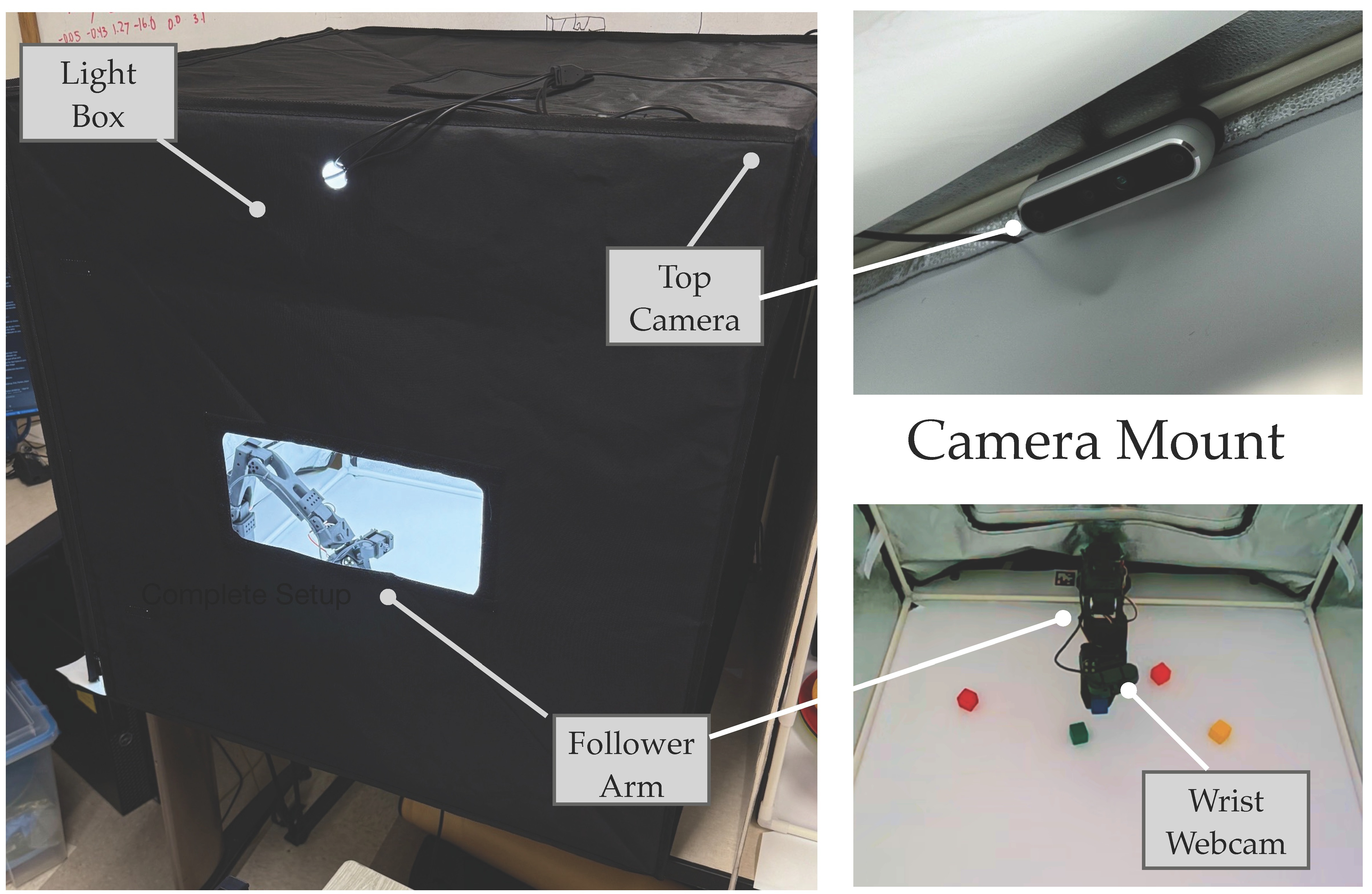
Create a stable physical workspace with consistent lighting, a light box where appropriate, and fixed external and wrist cameras.
STAGE 3 OF 5
Define a diverse benchmark suite—typically around 10 tasks—that reflects the robot’s capabilities and useful manipulation skills.
STAGE 4 OF 5
Create repeatable scene setups for every task, including object placement and in-distribution and out-of-distribution variations.
See VLA-Replica scene referencesSTAGE 5 OF 5
Run a baseline policy across the full suite to verify task feasibility, evaluation criteria, and the end-to-end protocol.
Tell us about your organization, robot platform, workspace, and the benchmark tasks you want to develop.